CFDs are complex instruments and come with a high risk of losing money rapidly due to leverage. 76% of retail investor accounts lose money when trading CFDs with this provider. You should consider whether you understand how CFDs work and whether you can afford to take the high risk of losing your money.
CFDs are complex instruments and come with a high risk of losing money rapidly due to leverage. 76% of retail investor accounts lose money when trading CFDs with this provider. You should consider whether you understand how CFDs work and whether you can afford to take the high risk of losing your money.


What is Thematic Investing? Types, Benefits & Risks
Financial markets can be grouped around individual companies, traditional sectors, or broader economic and technological trends. Thematic investing focuses on long-term developments that can influence multiple industries and businesses.
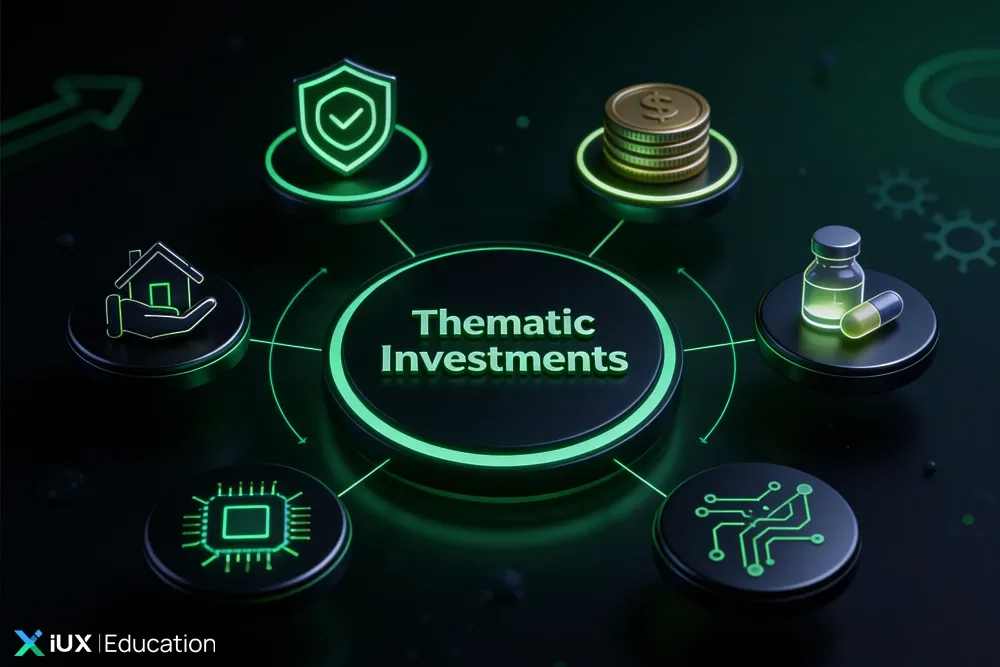
Themes such as artificial intelligence, clean energy, and healthcare innovation can span several traditional sectors. These themes can be reflected in different groups of companies and assets that are connected by a common long-term trend.
Understanding Thematic Investing
Thematic investing is an approach that focuses on a specific long-term trend rather than a single industry or company.
For example, artificial intelligence (AI) is not limited to software companies. The broader AI theme can extend across areas such as semiconductors, cloud computing, data centres, cybersecurity, and automation, because these industries can all be connected to the development and adoption of AI.
The key idea is to identify the broader trend first and then consider which industries, companies, or assets may be connected to that trend.
Thematic Investing vs Sector-based Investing
Sector-based investing focuses on established industry classifications such as Technology, Healthcare, Energy, or Financials.
Thematic investing instead follows a broader trend that may cross several sectors.
For example, a clean-energy theme could include companies involved in renewable power, batteries, energy storage, electric vehicles, and related infrastructure. These businesses may belong to different traditional sectors.
In simple terms, sector investing focuses on where a company fits in the existing economy, while thematic investing focuses on the broader trend connected to its business.
3 Popular Thematic Investing Themes in Financial Markets
Three commonly discussed themes include:
1. AI & Next-Generation Technology
AI encompasses areas such as machine learning, semiconductors, cloud computing, data infrastructure, software, and automation. Developments in technology, corporate investment, regulation, and earnings expectations can influence assets linked to this theme.
2. Clean Energy & Sustainable Transition
This theme covers areas such as renewable power, solar and wind energy, electric vehicles, batteries, and energy infrastructure. Policy developments, energy prices, technology, and infrastructure investment can affect related assets.
3. Healthcare Innovation & Aging Demographics
Population aging and healthcare innovation can influence areas including biotechnology, medical devices, pharmaceuticals, precision medicine, and healthcare infrastructure. While demographic trends develop over long periods, individual assets can still experience significant short-term price movements.
Ways to Gain Exposure to Thematic Assets
Thematic exposure can be obtained through different financial instruments, each with different structures and risks.
-
Stocks provide direct exposure to individual companies but also carry company-specific risks.
-
ETFs and investment funds can provide exposure to a basket of companies linked to a particular theme. Their holdings, weighting methodology, fees, and concentration can vary.
-
Thematic indices are indices designed to represent assets connected to a particular theme. Their composition and weighting depend on the index methodology.
-
Thematic Index CFDs provide derivative-based exposure to the price movement of a thematic index without ownership of the underlying assets. Depending on the product terms, positions can be taken on both rising and falling prices. Leverage can amplify the impact of market movements, while trading costs and financing charges may also apply.
Benefits & Risks of Thematic Investing
Potential benefits include:
-
Exposure to long-term structural trends
-
Access to themes spanning multiple industries
-
The ability to use different financial instruments for thematic exposure
Key risks include:
-
Concentration risk: A theme may be concentrated in a limited number of industries or companies.
-
Volatility: Assets linked to emerging themes can experience substantial price movements.
-
Valuation risk: Expectations about future growth may already be reflected in market prices.
-
Theme development risk: A promising trend may develop differently or more slowly than expected.
-
Leverage risk: For CFDs, leverage can magnify both gains and losses.
|
|
Tip: A long-term theme does not remove the risks associated with the underlying assets or financial instrument. |

💡FAQs
Q1: What financial instruments are used in thematic investing?
A: Common instruments include individual stocks, ETFs, investment funds, thematic indices, and Thematic Index CFDs. Stocks and funds can involve ownership or exposure to underlying assets, while CFDs provide derivative-based price exposure.
Q2: Is thematic investing suitable for short-term trading?
A: Thematic investing generally focuses on trends that develop over months or years. However, the theme itself and the trading time frame are separate concepts. Short-term market participants may analyse thematic developments as part of broader market context, while Thematic Index CFDs can provide shorter-term price exposure. Such trading remains subject to leverage, volatility, and other CFD risks.
Q3: What are megatrends in financial markets?
A: Megatrends are broad, long-term developments that can influence economies, industries, and consumer behaviour. Examples include technological innovation, demographic change, digitalisation, urbanisation, and the energy transition. Megatrends can provide the basis for thematic investing, but they do not determine the future performance of related assets.
Conclusion
Thematic investing focuses on long-term trends that can span multiple industries and businesses. Understanding the theme, its underlying drivers, and the risks of related assets or financial instruments can provide a more structured view of thematic markets. However, long-term themes do not guarantee future performance.
Note: CFDs are complex instruments and come with a high risk of losing money rapidly due to leverage. 76% of retail investor accounts lose money when trading CFDs with this provider. You should consider whether you understand how CFDs work and whether you can afford to take the high risk of losing your money.